


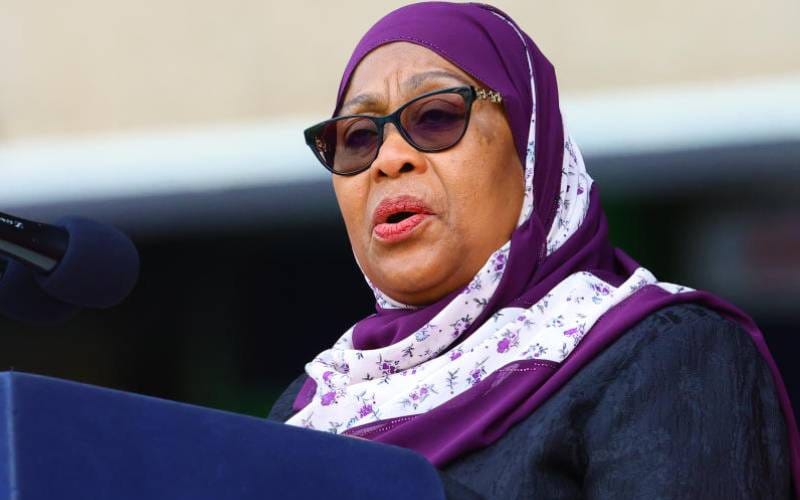
President Samia Suluhu Hassan has broken her silence on the violent police response to the October 29 protests, declaring that Tanzanian security forces are not uniquely brutal and that police in neighbouring countries routinely kill and injure their own citizens while pretending to be angels.
Speaking during a closed-door meeting with religious leaders at State House on Tuesday evening, the Head of State pushed back against international criticism, saying, “Sio polisi wetu tu ambao waliumiza watu, hata polisi wa nchi jirani wanaua na kuwaumiza viumbe vyao. Wasijifanye malaika. Tunawajua sana. Mambo yaliyofanyika 29th October hapa Tanzania, hata hawa majirani wanafanya hivyo hivyo tu.”
The remarks, captured on video by one of the attendees and quickly circulated on WhatsApp groups, mark the first time President Samia has directly addressed the events of October 29, when opposition supporters took to the streets demanding electoral reforms ahead of local government elections.
Human rights groups claim at least 27 people were killed and hundreds injured when police used live ammunition, teargas, and water cannons to disperse crowds in Dar es Salaam, Arusha, Mwanza, and Mbeya.
International condemnation was swift. The United States imposed targeted sanctions on senior police commanders, while the European Union suspended budget support pending an independent investigation.
Kenya’s President William Ruto and Uganda’s Yoweri Museveni had both issued carefully worded statements expressing concern over “excessive use of force” in a fellow East African Community member state.
President Samia’s comparison with neighbouring countries has sparked heated debate across the region. Kenya still vividly recalls the June and July 2024 protests, during which police killed over 60 demonstrators.
Ugandan opposition leader Bobi Wine frequently documents alleged police brutality against his supporters. Even in Rwanda, which maintains a reputation for strict order, reports occasionally surface of heavy-handed security operations.
Political analyst Jenerali Ulimwengu welcomed the President’s candour but warned that it does not absolve Tanzania of responsibility.
“Yes, police brutality happens everywhere, but that cannot be an excuse. The question is whether Tanzania is ready to investigate and punish those responsible, or whether we are now adopting the lowest regional standard,” he told journalists in Dar es Salaam.
Inside Chamwino State House, sources say the President made the remarks after religious leaders pressed her on the growing perception that Tanzania is sliding back toward the hardline tactics of the late President John Magufuli.
One bishop reportedly asked why peaceful protesters were treated like armed criminals. Samia is said to have responded that some demonstrators had attacked police stations and attempted to burn vehicles, justifying the forceful response.
The Tanzania Human Rights Defenders Coalition has rejected the comparison, insisting that the scale of violence on October 29 was unprecedented in recent Tanzanian history. “Neighbouring countries are not our benchmark. The people of Tanzania expect better from a government that promised ‘Hapa Kazi Tu’ and openness,” said coordinator Onesmo Olengurumwa.
Some praised the president for “speaking truth to hypocrites”, while others accused her of deflecting from domestic failures.
As Tanzania prepares to mark one month since the protests, pressure continues to mount for an independent commission of inquiry. Opposition leader Tundu Lissu dared the government to invite international observers to investigate all countries mentioned. “Let the African Union or United Nations come and see who the real angels and devils are,” he said.
For now, President Samia Suluhu Hassan has made it clear: Tanzania will not accept lectures from neighbours whose own police forces, in her view, have blood on their hands.