

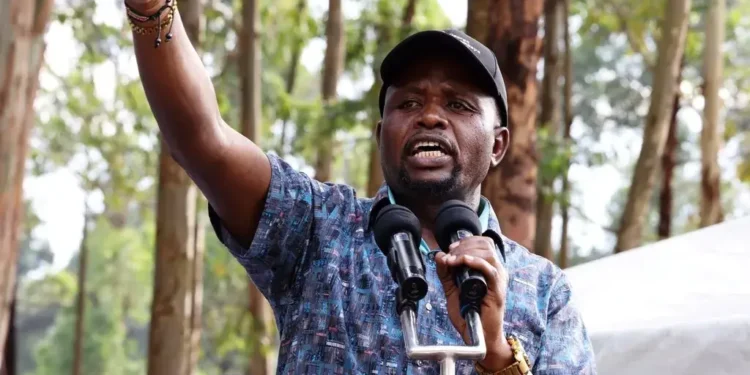
Kenyans in Trans Nzoia are now angry that Natembeya’s security was pulled before the by-elections. George Natembeya, the governor of Trans Nzoia, says that the Kenyan government took away his official security detail only one day before important by-elections on November 27, 2025.
This left him vulnerable at a time of growing political violence in Western Kenya. The prominent opposition figure, who leads the Tawe Movement, stated that his National Police Service bodyguards, assigned driver, and official vehicle were abruptly pulled late Tuesday night without any prior notice or explanation from authorities.
Natembeya, speaking to journalists in Kitale on Wednesday morning, described the move as a blatant intimidation tactic orchestrated at the highest levels of the Kenya Kwanza administration.
“This is unconstitutional and a clear scheme to silence me, as I support candidates challenging the ruling coalition in these polls,” he declared.
He directly blamed President William Ruto for the decision, adding that even his county vehicles could be next if the pressure escalates. Kenyan law under the National Police Service Act mandates state-provided security for governors, making the withdrawal a direct violation that has drawn sharp criticism from legal experts.
The timing could not be more suspicious, coming less than 24 hours before by-elections in several Western Kenya constituencies, including Kabuchai in neighbouring Bungoma County, where Natembeya actively campaigned for independent MCA candidate Erick Wekesa.
Malava Constituency, also nearby, features a hotly contested race that has seen Natembeya rally supporters against UDA candidates backed by Prime Cabinet Secretary Musalia Mudavadi.
Just last Saturday, November 22, Natembeya’s rally in Chwele Ward, Kabuchai, descended into chaos when unidentified gunmen opened fire and police lobbed tear gas canisters into the crowd, forcing the governor to cut short his speech and flee for safety.
Eyewitnesses from the disrupted event recounted a terrifying scene where supporters scattered amid popping gunfire and thick clouds of irritant gas. Natembeya, who was mid-address accusing National Assembly Speaker Moses Wetang’ula of orchestrating the violence, had to be whisked away by his then-present security team.
The attack followed a similar incident at the home of Kabuchai MP Majimbo Kalasinga, a Natembeya ally, where intruders vandalised the property and severely injured the watchman, amputating his hands and legs in the assault.
Kalasinga publicly blamed Wetang’ula’s forces for the brutality, echoing Natembeya’s claims of a coordinated effort to suppress opposition voices ahead of the polls.
Allies of the governor wasted no time in responding to the security withdrawal. By midday Wednesday, dozens of Tawe Movement supporters gathered outside the Trans Nzoia County Commissioner’s office in Kitale, chanting slogans against Ruto and Wetang’ula while holding placards demanding the immediate reinstatement of Natembeya’s protection.
“We will not be cowed by threats. If they touch George, they touch all of us,” shouted one protester, a local farmer who credited Natembeya’s administration for improving irrigation projects in the region.
The demonstration remained peaceful but highlighted the simmering tensions in Trans Nzoia, a county long seen as a battleground for Luhya politics.
Natembeya, undeterred, vowed to press on with his campaign schedule, stating he would travel to the by-election hotspots using private means if necessary.
“They can take my car and guards, but they cannot take my resolve to fight for fair elections and development,” he said. His office confirmed plans for enhanced personal security funded by county resources, though aides expressed concerns over the sustainability of such measures.
The fact that the governor used to be the Rift Valley Regional Commissioner and dealt with security concerns head-on makes the present situation even more ironic, as he is now being targeted in the exact system he helped strengthen.
Political observers saw the event as part of a larger trend of harassment targeting opposition politicians in Kenya before elections.
Dr Mutinda Kimeu, a political science professor at the University of Nairobi, warned local news that taking away state protection from elected officials goes against democratic principles and might make people lose faith in the Independent Electoral and Boundaries Commission.
“This isn’t just about Natembeya; it’s a signal to all critics of the government ahead of 2027,” Kimeu warned, referencing recent threats from Mudavadi against the governor’s re-election bid.
Mudavadi, speaking at a forum in Malava just days before the attacks, had cautioned Natembeya against “throwing stones in a glass house,” implying his political manoeuvres would invite backlash.
The Prime Cabinet Secretary even hinted at grooming challengers like former Cabinet Secretary Susan Nakhumicha and ex-MP Chris Wamalwa to unseat Natembeya in the next general elections.
Natembeya fired back earlier this week, daring Mudavadi to field a candidate directly rather than relying on proxies. As of Wednesday evening, no official response has emerged from the Interior Ministry or the National Police Service regarding the withdrawal.
Sources within the security apparatus, speaking off the record, suggested the move stemmed from “administrative reshuffles” but declined to elaborate.
Rights organisations, such as the Kenya National Commission on Human Rights, have asked for an impartial investigation. They say that governors’ security is a legal right that shouldn’t be affected by politics.
The by-elections, which were called because sitting MPs and MCAs died, are very important in Western Kenya’s politics because they could set the stage for the 2027 presidential race.
Voter participation in Kabuchai and Malava is likely to be high because of the recent violence and Natembeya’s strong support for candidates who are against the establishment.
His Tawe Movement, which was started to give voice to regional complaints, has gathered support among young people and farmers in Trans Nzoia who are angry over broken promises about land reforms and job prospects.
This ongoing drama shows how weak opposition politics are in Kenya, where threats of violence and institutional moves frequently clash. Many people are wondering whether Natembeya’s absence from the elections is the start of further crackdowns or a call to action for democratic protections.
With votes poised to drop tomorrow, everyone is still watching Western Kenya. There, one governor’s weakness might change the course of a much wider power battle.