
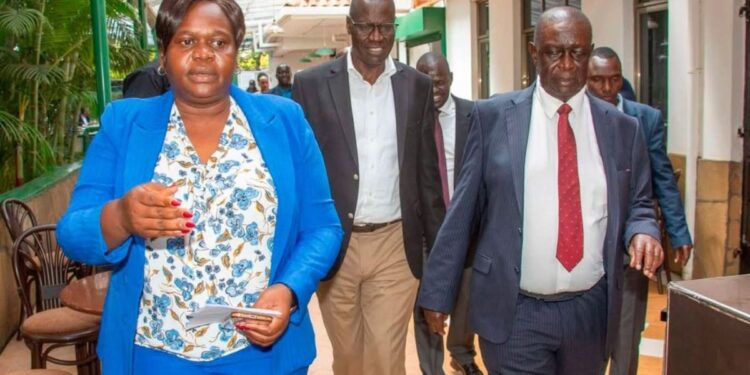
Gladys Wanga, Oburu Odinga, and ODM Sifuna’s plea has thrown Kenyan politics into fresh drama as two big names in the Orange Democratic Movement ask the Political Parties Disputes Tribunal to step back and let the party sort its own mess first. The move comes at a tense time inside ODM where internal fights have spilt into public view and now threaten to drag outsiders into what many see as a family affair.
Gladys Wanga, the Homa Bay governor, and Oburu Odinga, the Siaya senator and brother to Raila Odinga, filed the request together. They are requesting the tribunal to allow ODM to address the Edwin Sifuna issue privately before any external ruling is made.
Sifuna, the vocal deputy secretary general of the party, has been at the centre of sharp disagreements over leadership style, party direction and recent public statements that some members say went too far.
The case landed at the tribunal after complaints from within the party accused him of undermining unity and crossing lines that could hurt ODM ahead of future elections.
Wanga and Oburu contend that hastily approaching the tribunal bypasses the standard procedures that every party should adhere to when internal conflicts arise.
They say ODM has its own rules and disciplinary committees that can sit down with Sifuna, talk things through and reach a fair outcome without washing dirty linen in public.
Their plea highlights a bigger worry that constant court battles make the party look weak and divided at a moment when unity matters most. Supporters of the pair point out that ODM has survived bigger storms by fixing problems quietly, and they believe this situation deserves the same chance.
The request has split opinions inside and outside the party. Some senior ODM figures quietly agree with Wanga and Oburu, saying internal handling keeps control where it belongs and stops rivals from laughing at the chaos.
However, others believe that Sifuna’s case requires a new perspective, as previous attempts to resolve it through discussion have been unsuccessful. They are concerned that allowing the party to make a unilateral decision could result in a lenient outcome for one faction, while disregarding the genuine grievances of the other.
The tribunal itself has not yet ruled on the plea, but the mere fact that two heavyweights stepped forward together shows how seriously they take the risk of losing grip on party matters.
Edwin Sifuna built his name as a no-nonsense voice who calls things as he sees them. He has never shied away from criticising party decisions or pushing for tougher stands on national issues.
That straight talk earned him fans among younger members who want ODM to stay sharp and relevant. Yet the same style has also created enemies within the ranks who say he sometimes forgets he speaks for the whole party, not just himself.
The current case revolves around specific remarks and actions that opponents claim damaged ODM’s image and weakened its bargaining power in national coalitions.
For ordinary Kenyans who follow politics the story feels familiar. Parties in Kenya often fight these battles in the open, and the public ends up watching like it is another soap opera.
This time, though, the involvement of Wanga and Oburu adds weight because both carry long histories in ODM and command respect across the region.
Their joint plea suggests the party leadership wants to avoid a repeat of past splits that cost votes and influence in previous elections. They know that heading into 2027 with fresh wounds could hand easy points to rivals who already circle looking for weaknesses.
The tribunal now sits with a simple but important choice. Grant the request and let ODM try one more round of internal talks or push ahead with its own hearing and risk being seen as meddling in party affairs.
In the meantime, Sifuna himself has kept a low profile, though close allies say he remains ready to defend his record and his right to speak freely. The rest of ODM continues its daily work of mobilising members and preparing for upcoming by-elections, but the cloud of this case hangs over every meeting.
Wanga and Oburu have made it clear they believe the party can heal itself if given the room, and many in the rank and file hope they are right.
The plea also highlights the increasing pressure within opposition parties to maintain unity as the next general election approaches. With President William Ruto gaining ground in some regions, ODM cannot afford endless internal noise that distracts from bigger goals.
Wanga and Oburu appear to comprehend this, and their actions seem to be an effort to unite before the situation escalates. Whether the tribunal listens or not, the conversation has already started about how much loyalty and discipline the party can demand from its outspoken members.
Kenya has watched these kinds of dramas play out many times, yet each one still draws crowds because politics here touches daily life in ways few other topics do.
From market traders in Kisumu to office workers in Nairobi, people pause to ask what it means for the future of ODM and whether this Sifuna case will end quietly or blow up into something larger.