
Tanzania Meta Bans Maria Sarungi, Mange Kimambi on Instagram and WhatsApp
 Ibrahim Mohamed — December 5, 2025
The escalating clash between the Tanzanian government and Meta has reached a critical point with the sudden Tanzania Meta ban that silenced three prominent activists on Instagram and WhatsApp, sparking widespread concern over online freedom in the East African nation.
The restrictions, confirmed by Meta itself in the past 48 hours, follow weeks of behind-the-scenes pressure from authorities who openly threatened to block Facebook, Instagram, and WhatsApp across the entire country unless the company complied with demands to remove specific accounts.
At the centre of the Tanzania Meta ban storm are three outspoken critics of President Samia Suluhu Hassan’s administration: Maria Sarungi-Tsehai, Mange Kimambi, and a third activist whose identity remains partially shielded in official statements.
Sources familiar with the matter revealed that Tanzanian regulators issued formal legal orders citing national security concerns and alleged dissemination of false information ahead of local government elections scheduled for late 2025. Meta’s transparency report, quietly updated on December 3, 2025, confirms that Maria Sarungi-Tsehai’s popular Instagram account (@mariastz) was permanently disabled in Tanzania following a direct government request.
Users attempting to access her page from Tanzanian IP addresses now see only a blank screen and the standard message: “This content isn’t available right now.”
The second activist targeted, Mange Kimambi, known for her fiery commentary on politics and celebrity gossip, received an even broader punishment. Meta representatives confirmed to local journalists that Kimambi was banned from both Instagram and WhatsApp after multiple violations of community standards, including repeated posts flagged as hate speech and incitement.
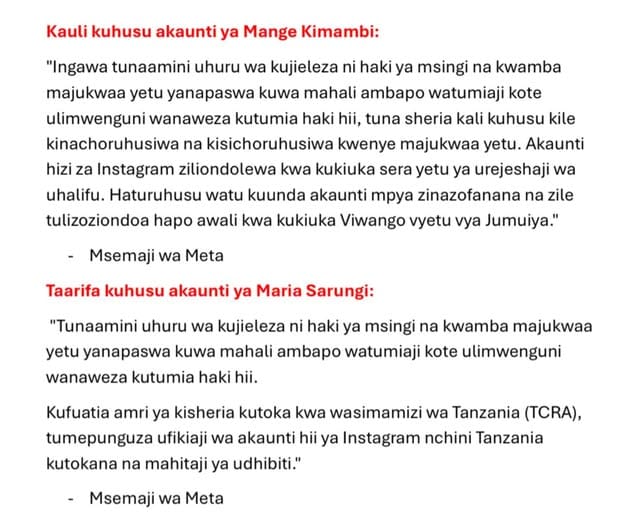
Screenshots circulating on alternative platforms show Kimambi’s final Instagram story, posted hours before the ban, accusing certain officials of corruption in the ongoing Zanzibar constitutional review process. Her WhatsApp account, widely used to coordinate with supporters, also went dark, preventing her from sending or receiving messages within Tanzania.
The third activist, referred to only by initials in court documents seen by bana.co.ke, had their reach severely restricted rather than a full ban. Posts now carry warning labels, and the account no longer appears in search results or recommended feeds for Tanzanian users. Digital rights observers describe this as a “shadow ban” tactic increasingly favoured by governments seeking plausible deniability.
The Tanzania Meta ban threat first surfaced in mid-November when the Tanzania Communications Regulatory Authority (TCRA) summoned Meta’s East Africa representatives to a closed-door meeting in Dar es Salaam.
According to leaked minutes obtained by independent media, officials warned that failure to act against the three accounts within fourteen days would trigger nationwide blocking of all Meta-owned platforms, similar to measures taken against Twitter (now X) in 2021. The deadline quietly expired on November 30, and the restrictions began rolling out almost immediately.
Civil society groups reacted with alarm. The Tanzania Human Rights Defenders Coalition called the move “a dangerous precedent that turns private companies into state censorship agents.”
Executive director Onesmo Olengurumwa told reporters outside the coalition’s offices in Ubungo that the government was exploiting vague provisions in the 2015 Cybercrimes Act and the newer Online Content Regulations to silence dissent ahead of crucial civic elections. “These activists were not posting threats or violence,” he stressed. “They were asking legitimate questions about transparency and accountability.”
Meta’s official statement, released late Wednesday, walked a careful line. “We comply with valid legal requests from governments while working to preserve voice for our users,” a spokesperson wrote.
“In this case, we were compelled to restrict certain accounts in Tanzania under local law, but we continue to push back against overbroad demands.” The company pointed out that Maria Sarungi-Tsehai’s account remains accessible outside Tanzania, showing that the block is geofenced to the country’s borders.
Internet freedom monitors report an immediate chilling effect. Traffic to virtual private network (VPN) services spiked in Tanzania within hours of the bans, as citizens rushed to circumvent restrictions.
Popular alternatives such as Telegram and Signal recorded sharp increases in downloads from the Google Play Store and Apple App Store in the region. Meanwhile, screenshots of the banned accounts are being shared widely on TikTok and smaller Tanzanian forums, keeping the activists’ messages alive through digital samizdat.
Political analysts see the Tanzania Meta ban as part of a broader pattern. Since President Samia took office in 2021, her administration has balanced promises of greater openness with periodic crackdowns on critical voices online. The timing, just weeks after local elections and amid heated debate over constitutional changes in semi-autonomous Zanzibar, has fuelled speculation that authorities are clearing the digital battlefield of influential opponents.
As of Thursday evening, no official comment has come from State House or the Ministry of Information. However, government-aligned commentators on local radio stations have defended the measures, claiming the activists were spreading “dangerous falsehoods” that could incite unrest. One pro-government blogger went so far as to celebrate the restrictions, posting, “Finally, peace returns to our timelines.”
For now, three of Tanzania’s loudest online voices have been muted within their own country. Whether this marks the beginning of wider internet controls or simply a targeted strike remains unclear. What is certain is that the Tanzania Meta ban has thrust the delicate relationship between global tech giants and African governments back into the spotlight, reminding millions that freedom of expression online often hangs by the thinnest of threads.
Related Posts
President Museveni Calls Sex Denial In Marriage Jailable Offense
Uganda President Yoweri Museveni stirred fresh controversy when he declared denying your partner sex a big offence that could land people in jail. The veteran…

Uri Geller Cancels Witch Doctor Nana Kwaku Curse on Harry Kane
Uri Geller stepped in to cancel the witch doctor’s curse on Harry Kane right before England faced Ghana in the World Cup. The Israeli-British illusionist…

Didier Deschamps Mourns Mother’s Death Ahead of Norway Game
France national team coach Didier Deschamps faces sudden heartbreak as news of his mother’s death spreads through the football world. The long-time leader will fly…
JD Vance Delivers Blunt Warning to Netanyahu Government
Vice President JD Vance issued a fierce warning to Benjamin Netanyahu’s cabinet on Thursday against undermining their crucial American partnership over President Donald Trump’s new…