
Why Chinese Super League Kicks Off with Half Teams on Negative Points
 Rama Chibu
— March 8, 2026
Rama Chibu
— March 8, 2026 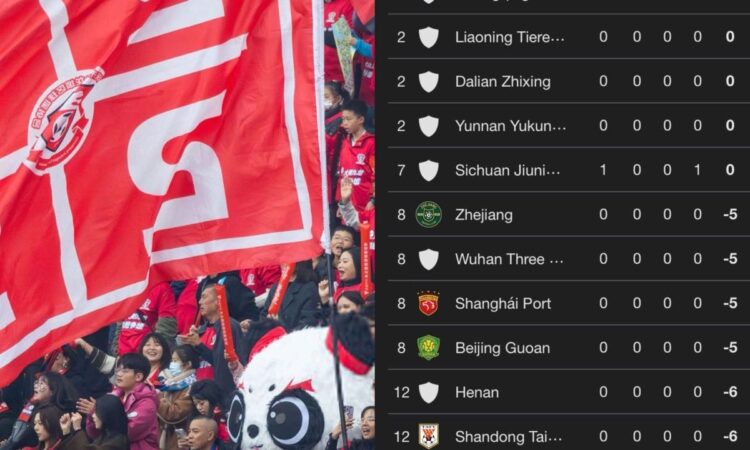
The Chinese Super League kicks off with nine teams on minus points after a sweeping crackdown on match-fixing left more than half the league starting the 2026 season in the red. The unusual table emerged when the campaign launched this month, turning what should have been a fresh start into a scramble for redemption amid penalties handed down late last year.
In January, the Chinese Football Association conducted a thorough investigation into years-long gambling, bribery, and game rigging. Thirteen clubs across divisions took hits, but nine in the top flight bore the brunt.
Shanghai Shenhua and Tianjin Jinmen Tiger faced the most severe penalties, each receiving a 10-point deduction, which left them at minus 10 from the start of Matchday One. Shanghai Port, the reigning champion, started at minus-5. Others, like Qingdao Hainiu, sat at minus-7, while Henan FC, Shandong Taishan, Zhejiang FC, Beijing Guoan, and Wuhan Three Towns hovered between minus-5 and minus-6.
The league has 16 teams, so over half began buried in negative territory. This meant that after the opening round, a team like Dalian Zhixing could lose yet still rank higher than well-known teams that won but incurred heavy deductions.
One club even notched a 5-3 victory yet ended up at minus 7, while their beaten opponents landed in fifth with zero points. At first glance, fans and observers referred to the standings as bizarre and almost comical, but the reality suggests a serious attempt to clean up the sport.
This crackdown ties into a broader purge that banned 73 people from football for life, including former association bosses and national team coach Li Tie. Authorities characterised it as a campaign aimed at addressing the issues of “fake, gambling, and black” that plague the sport.
Fines ranged from 200,000 to one million yuan, roughly 26,000 to 132,000 dollars, depending on the severity. Some punished sides had already dropped to lower leagues, but the top-tier teams now face an uphill battle to climb out of the hole, as they must not only recover from point deductions but also rebuild their teams and regain the trust of their fans.
Players and coaches feel the weight. Shanghai Shenhua, last year’s runners-up, is deeply affected by the 10-point penalty following a robust campaign. Tianjin Jinmen Tiger, never relegated since the league began in 1994, now fights just to stay afloat.
Shanghai Port defends their title from minus five, a deficit that could decide the race early. Managers talk about focusing on one game at a time, but the maths is unforgiving, as each match lost increases the pressure to perform in subsequent games to avoid relegation. Win consistently to erase the gap, or risk sliding toward relegation trouble.
Supporters react with mixed feelings. Some praise the authorities for finally tackling deep-rooted issues that damaged credibility, such as financial mismanagement and lack of transparency in decision-making. Others worry the harsh measures could weaken the league’s competitiveness, especially with big clubs handicapped, potentially leading to a less exciting season and diminished fan engagement.
Fans are uncertain about the fairness of the season, casting doubt on attendance and TV interest. Memes depicting upside-down tables and jokes about negative points are circulating on social media, transforming football into a distinct sport.
The penalties stem from scandals involving fixed matches for betting profits, bribes to officials, and corruption that eroded trust. Investigators uncovered cases dating back to 2012 in some instances, showing how long the problems festered.
The CFA says the actions aim to restore integrity and make Chinese football healthier long-term. Whether it works depends on how teams respond on the pitch and if stricter oversight prevents repeats.
Early matches show resilience. Some deducted sides grabbed wins or draws, chipping away at the deficit slowly. Chengdu Rongcheng, one of the few teams without punishment for rule violations, hosts games with a clean slate, adding pressure on the penalised pack. The schedule runs tight, with no break for the World Cup in June and July, so every point counts double.
This season stands apart from any before. Negative starts reshape strategies, from aggressive signings to defensive mindsets, as teams scramble to recover lost points and adjust their tactics to remain competitive in the league. For neutrals, it offers drama, watching giants claw back from impossible positions.
For purists, it highlights the cost of past sins, such as financial mismanagement and the impact on team integrity and performance. As the campaign unfolds, Chinese Super League fans watch closely, hoping the cleanup leads to better football rather than lingering resentment. The table looks strange now, but it might just force a reckoning that the sport needed, leading to improved governance and a more competitive environment in the Chinese Super League.