















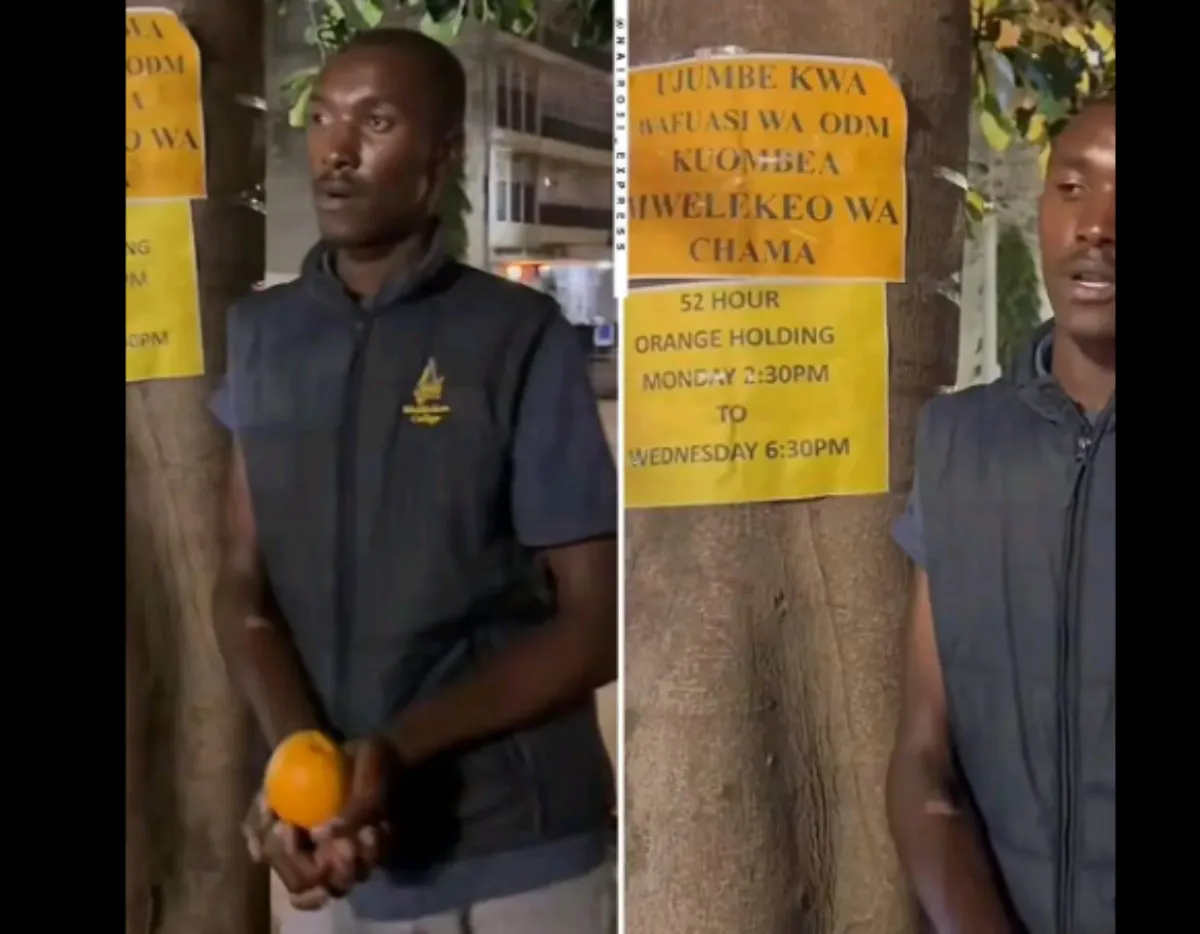
A man in Nairobi has held an orange for 52 hours straight to call for change in the direction of the Orange Democratic Movement’s leadership. The protest began on January 18, 2026, outside the ODM offices in the city center.
The demonstrator, who identified himself only as a concerned party supporter, said he chose an orange to symbolize the party name and its long-standing roots in opposition politics. He stood in one spot, orange in hand, refusing to let go even as rain fell and temperatures dropped at night.
The man spoke to passers-by and journalists who stopped by. He explained that he wants ODM to return to its original mission of fighting for ordinary Kenyans rather than staying in government coalitions.
“Raila built this party on principle,” he said. “Now it feels like we are just following others. I will hold this orange until leaders listen.” He did not name specific people but pointed to recent decisions that he believes go against what ODM once stood for.
The protest drew attention slowly at first. A few people took photos. By the second day, small crowds gathered. Some brought him water and a stool to rest his legs, though he still kept the orange raised. Others argued with him, saying the party needs to adapt to survive.
A handful of ODM supporters stopped to listen. One young man said he agreed the party had lost its fire. An older woman told him to go home and stop wasting time.
By the 52-hour mark, the man’s hand had swollen. Friends urged him to stop. He finally released the orange on January 20, 2026, after doctors checked him for dehydration and circulation problems.
He told reporters he felt the message had reached some people. “I did what I could. Now it’s on the leaders,” he said. He did not plan to continue the protest but said he would keep speaking out in other ways.
ODM has faced internal questions since Raila Odinga’s death in October 2025. The party now operates under interim leadership with Dr. Oburu Oginga at the helm. Some members support closer ties with President Ruto’s government for practical gains like jobs and projects.
Others argue it betrays the party’s history as a voice for the marginalized. Parallel rallies in recent weeks—one led by Oburu in Kakamega and another by Raila’s children in Kibera—showed the divide clearly.
This lone protest in Nairobi adds another voice to that conversation. The man did not belong to any official faction. He said he acted alone because he felt ordinary members are not being heard. His action reminded some of earlier symbolic protests in Kenya, like hunger strikes or sit-ins, used to highlight political grievances.
Party officials have focused on upcoming county tours and membership drives. Critics online called the orange protest creative but unlikely to change much. Supporters said every small act keeps pressure on leaders.
The orange itself became a small symbol. Photos of the man holding it spread on WhatsApp groups and X. Some joked about “orange revolution.” Others took it seriously as a sign of frustration at the grassroots level.
ODM remains one of Kenya’s largest parties with strong support in Nyanza, parts of Nairobi, and the Coast. The leadership question will likely dominate internal discussions in the coming months. The 2027 elections are still far off, but early moves shape the path.
This man’s 52-hour stand was small in scale but clear in message. He wanted the party to remember why it was formed. Whether leaders listen remains to be seen. For now, the orange sits as a quiet reminder in the middle of Nairobi’s busy streets.