
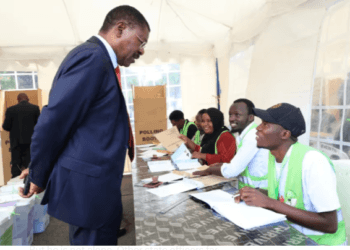









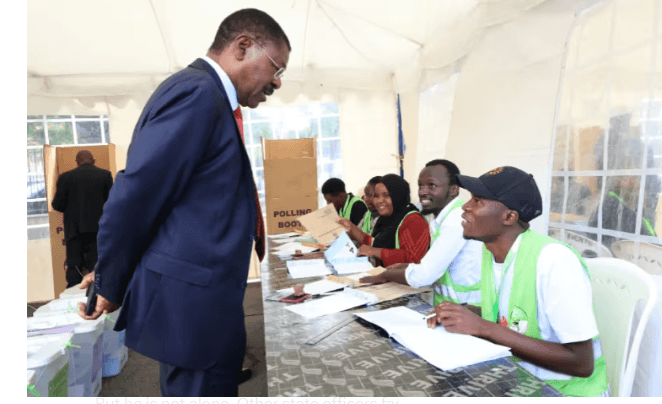
National Assembly Speaker Moses Wetangula got barred from the LSK vote today in a surprising twist at the Supreme Court polling centre. He showed up ready to cast his ballot in the Law Society of Kenya elections but hit a wall when his name was missing from the register.
Officials pointed to a rule about needing a valid practising certificate, something state officers like him usually skip while in office. This left many talking about how such technicalities can trip up even big names in Kenyan politics.
Wetangula arrived a bit after 10 a.m., looking sharp in his suit. He approached the desk expecting a smooth process. Instead, he spent time chatting with Independent Electoral and Boundaries Commission folks trying to sort it out. No luck.
The LSK Election Board Secretary, Owiso Owiso, laid it out plain. He said state officers do not take practising certificates, so they end up off the voter roll unless they grab one. Wetangula pushed back. He argued that as Speaker, he is not out there practising law every day, so why bother with the certificate?
He even said the society told them it was not needed. But Owiso held firm. He reminded everyone that members, including Wetangula, voted for this rule themselves. It is there to make sure only active lawyers have a say.
Picture this. A high-powered figure like Wetangula standing there, papers in hand, facing a simple no from election workers. It is the kind of moment that shows rules apply to all, or at least that is the idea. Social media lit up with reactions.
Some folks saw it as a win for fairness; others called it petty. One post from a lawyer celebrated the outcome, saying it keeps the society focused on real practitioners. Wetangula did not make a big scene. He left without voting, but his point lingered. Is this rule fair for leaders who step away from the courtroom but still care about the legal world?
The elections went on without much hitch elsewhere. Voting kicked off at 6 a.m. and picked up steam by mid-morning. Big names turned out early. Think Nairobi Senator Edwin Sifuna, Makueni Governor Mutula Kilonzo Jr, Party of National Unity leader Martha Karua, and even former presidential hopeful Ekuru Aukot. They all breezed through.
Sifuna had words after his vote. He praised the LSK for standing strong against bad governance over the past couple of years. He said it has been key in pushing back on power abuses. That kind of talk shows why these polls matter. The LSK often takes on the government in court, shaping how laws play out for everyday Kenyans.
A few glitches popped up. At Milimani Law Courts, some voters got sent away for using the wrong gate. It frustrated people enough that a handful walked off without casting ballots.
Vice presidential hopeful Teresia Wavinya noted that. She worried it might keep turnout low. There were whispers of folks trying to sway votes right at the station, but officials stepped in quick. Overall, the setup felt solid, with the IEBC running things.
By evening, polls wrapped up. Senior Counsel Charles Kanjama came out on top as the new LSK president. He pulled in 3,728 votes, beating out Peter Wanyama and Mwaura Kabata. Congratulations poured in online.
One user called it a fresh start, hoping Kanjama builds on what outgoing president Faith Odhiambo started. Odhiambo got credit for boosting the society’s role and gaining public trust. Now Kanjama steps in at a time when Kenya gears up for the next big elections in 2027.
Wetangula’s snag brings up bigger questions. The LSK has over 18,000 members, but rules like this might shut out voices from government circles. Some say it protects the group’s independence.
Others think it needs a rethink to include all admitted advocates. Wetangula himself helped pass the rule, so irony there. But he is not alone. Other state officers face the same bar.
Looking back, the 2024 LSK polls saw about 48 per cent turnout, with Odhiambo winning in a crowded field. Kanjama ran on reform and unity. His win signals members want steady hands amid national debates on everything from taxes to security.
Social media kept buzzing post-results. Posts hailed Kanjama as the 52nd president, urging him to keep the LSK fearless. One standout message hoped the society stays true to the constitution, no matter who is in power. That sums it up. Kenyans watch the LSK closely because it often fights battles that affect us all.
This day in Nairobi showed democracy’s quirks. As tallying finished, the focus shifts to what Kanjama does next. Will he tackle the practising certificate issue? Time tells. For now, the legal community moves forward, ready for whatever comes.