
Mogadishu Erupts in Protests Over Trump’s Somali Garbage Insult

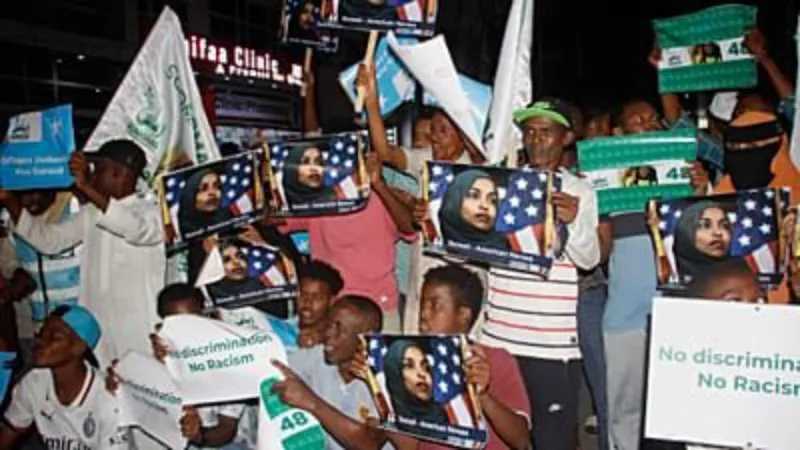
Mogadishu erupts in protests over Trump’s Somali garbage insult as hundreds of furious residents took to the sun-baked streets of Somalia’s capital on Friday, December 5, 2025, their voices rising in a chorus of defiance against the U.S. president’s dehumanising words. What began as a spontaneous gathering near the iconic Lido Beach quickly swelled into a sea of green, white, and red Somali flags, with marchers clutching handmade placards reading “We Are Not Garbage, We Are Gold” and “Trump’s Words Fuel Hate, Not Hope.”
At the heart of the rally stood larger-than-life photos of U.S. Rep. Ilhan Omar, the Minnesota Democrat and Somali refugee turned congresswoman, hoisted high as a beacon of resilience and unyielding pride.
For the demonstrators, many of whom have family ties to the Somali diaspora in America, the insult transcended mere rhetoric; it struck at the core of their shared identity, evoking memories of civil war scars, refugee camps, and the hard-won dignity of rebuilding lives across oceans.
The spark for the unrest traces back to Tuesday’s White House cabinet meeting, where President Donald Trump unleashed a blistering tirade against Somali immigrants, branding them “garbage”.
He bluntly declared, “We don’t want them in our country.” Flanked by Vice President JD Vance, who reportedly pounded the table in approval, Trump escalated his longstanding fixation on the community, accusing them of welfare dependency, fraud, and cultural incompatibility. “Their country stinks, and we don’t want them here,” he repeated, weaving in barbs at Rep. Omar, whom he separately labelled “garbage” and unfit for office.
The outburst, captured on live television, came amid reports of a ramped-up Immigration and Customs Enforcement operation in Minneapolis-St. Paul, dubbed Operation Metro Surge, where about 100 agents targeted undocumented Somalis in the state’s “Little Mogadishu” enclave.
Federal prosecutors had recently highlighted a multi-year fraud scheme allegedly costing Minnesota tens of millions in misused social services, though community leaders stress the perpetrators represent a tiny fraction of the 260,000-strong Somali American population.
In Mogadishu, the reaction unfolded under a hazy afternoon sky, with protesters weaving through the bustling Bakara Market district before converging on the presidential palace. Chants of “Somalia Strong, America Hear Us” echoed off bullet-pocked walls, a stark reminder of the nation’s battles against al-Shabab militants and clan rivalries.
Organisers, including youth activist Amina Hassan, a 28-year-old university student who lost her father to the 2017 truck bombing, described the march as a “collective exhale of pain”. “Trump’s garbage label doesn’t just hurt our brothers and sisters in Minnesota; it poisons the well of global respect for all Africans,” Hassan told reporters, her hijab fluttering in the salty breeze from the Indian Ocean.
The demonstrations remained peaceful, policed by a visible but restrained contingent of Somali National Army troops, though tensions simmered as a small counter-group of government critics waved signs accusing local leaders of silence.
Prime Minister Hamza Abdi Barre, speaking earlier at an innovation summit, had urged restraint, stating it was “better not to respond” to Trump’s barbs, a stance that drew boos from some attendees. Barre’s measured tone contrasted sharply with the raw emotion on the streets, where vendor-turned-protester Yusuf Ali, 42, gripped a photo of his nephew in Ohio.
“My family fled Mogadishu’s chaos for America’s promise, only to face this,” Ali said, his voice cracking. “We build businesses, pay taxes, and serve in the military. Garbage? No, we are the backbone of both nations.” Independent observers noted the rally’s scale, estimated at 800 strong, as one of the largest anti-U.S. sentiment expressions since the 2020 George Floyd protests rippled globally.
Across the Atlantic, echoes of Mogadishu’s fury reverberated in Minnesota, where Somali community hubs like the Cedar-Riverside neighbourhood buzzed with emergency town halls. Minneapolis Mayor Jacob Frey, flanked by religious leaders, vowed non-cooperation with federal raids, declaring, “Our Somali neighbours are woven into this city’s fabric, and we’re not unravelling it for politics.”
Rep. Omar, undeterred, fired back on social media: “Your obsession is creepy, Mr. President. Get the help you need.” Even some Trump voters distanced themselves; Salman Fiqy, a Somali American who backed the GOP in 2024, appeared on CNN decrying the remarks as “dehumanising and unpresidential”, vowing to withhold future support.
Faith voices joined the chorus too, with Rev. Paul Graham of St Ansgar’s Church in Cannon Falls rebuking Trump in Jesus’ name: “No human is garbage; Somalis are our neighbours and God’s children.”
Broader ripples reached U.S. allies and foes alike. In the Horn of Africa, Ethiopian Prime Minister Abiy Ahmed offered quiet solidarity via a tweet praising Somali resilience, while al-Shabab propagandists swiftly co-opted the footage for recruitment videos, warning of “infidel crusades”.
European diplomats, wary of aid cuts under Trump’s renewed “America First” push, monitored the unrest closely; the U.S. funnelled $128 million to Somalia this fiscal year for counterterrorism alone. Analysts like those at the Elman Peace and Human Rights Centre in Mogadishu, led by Nobel nominee Ilwad Elman, highlighted the irony: Trump’s words, meant to rally his base amid fraud scandals, instead galvanised a narrative of African agency.
“From Lido Beach therapies healing trauma to free ambulances racing through our streets, Somalis prove our worth daily,” Elman said, referencing Dr Abdulkadir Abdirahman Adan’s volunteer service post-al-Shabab attacks.
As dusk fell on Friday’s march, participants dispersed to beachside cafes, sharing tea and tales of diaspora triumphs, from Somali-owned eateries in Columbus to tech startups in Seattle. Yet the sting lingered, fuelling calls for diplomatic pushback.
Somali traders like Abdullahi Omar, 35, who lost land to corruption back home, mixed condemnation with reluctant agreement on governance woes but insisted, “Trump’s truth is wrapped in poison; we demand defence from our leaders.” In a nation where remittances top $1.6 billion annually, mostly from the U.S., the insult threatens fragile ties.
International watchdogs, including the BBC and Al Jazeera, captured the event’s dual edge: outrage abroad mirroring Minnesota’s fears, where businesses shuttered amid ICE sweeps and hate incidents spiked 30% post-rant, per CAIR reports.
Mogadishu erupts in protests over Trump’s ‘Somali garbage’ insult, which encapsulates a pivotal moment in transatlantic relations, where a single slur exposes fault lines of race, migration, and power. For Somalis, it’s a clarion call to reclaim narratives, from ancestral ports to American heartlands.
As Saturday dawned with cleanup crews sweeping placard remnants, the resolve hardened: dignity isn’t negotiable, and Africa’s voice grows louder.
In boardrooms and bazaars, the message rings clear, urging global leaders to elevate humanity over hate, lest words like “garbage” ignite divides too deep to bridge. The road ahead demands dialogue, not disdain, to honour the shared humanity that binds fractured worlds.
Related Posts
President Museveni Calls Sex Denial In Marriage Jailable Offense
Uganda President Yoweri Museveni stirred fresh controversy when he declared denying your partner sex a big offence that could land people in jail. The veteran…

Uri Geller Cancels Witch Doctor Nana Kwaku Curse on Harry Kane
Uri Geller stepped in to cancel the witch doctor’s curse on Harry Kane right before England faced Ghana in the World Cup. The Israeli-British illusionist…
Didier Deschamps Mourns Mother’s Death Ahead of Norway Game
France national team coach Didier Deschamps faces sudden heartbreak as news of his mother’s death spreads through the football world. The long-time leader will fly…
JD Vance Delivers Blunt Warning to Netanyahu Government
Vice President JD Vance issued a fierce warning to Benjamin Netanyahu’s cabinet on Thursday against undermining their crucial American partnership over President Donald Trump’s new…