
Mokaya Sues Safaricom for 200M in Data Breach

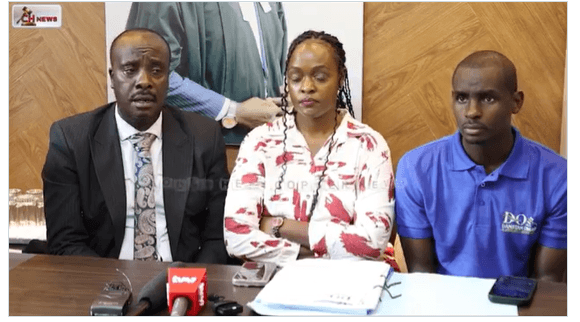
Just a day after walking free from court, university student David Mokaya is hitting back hard at Safaricom over what his lawyers call a blatant Safaricom data breach. The young man, who spent months fighting charges of spreading fake news about President William Ruto, now wants the telecom giant to pay him 200 million Kenyan shillings for handing over his personal info to police without a proper court order. It’s a move that could shake up how companies handle our private details in Kenya.
Let me take you back to the beginning of this. In November 2024, Mokaya, a 24-year-old finance student at Moi University in Eldoret, came into trouble because of a post on social media.
The prosecutor said he shared a photo on X – that’s the old Twitter – showing a coffin draped in the Kenyan flag with Ruto’s picture on it, like some kind of funeral procession.
The caption supposedly read something about the president’s body leaving a funeral home, escorted by the army. It caused a stir, with people thinking it was real and aimed at stirring trouble.
Mokaya got arrested, his phone and laptop seized, and he faced charges under the Computer Misuse and Cybercrimes Act for publishing false information. He always said he didn’t do it, even disowning the account linked to the post.
The trial dragged on, and things got intriguing when a police officer from the DCI’s Serious Crimes Unit took the stand. Chief Inspector Bosco Kisau admitted that Safaricom gave them Mokaya’s details – including his phone number, location data, and call records – based just on a letter from investigators.
No judge signed off on it, no warrant in sight. That raised eyebrows because Kenya’s Data Protection Act and the Constitution are pretty clear: you can’t just hand over someone’s private info like that without legal backing.
A Safaricom employee later confirmed in court that they released the data the same day they got the request, without asking for proof it was authorised.
If you’re reading this today, fast forward to February 19, 2026 – yesterday. Milimani Senior Principal Magistrate Caroline Nyaguthi threw out the case against Mokaya. She said the prosecution couldn’t prove he was behind the post.
There were holes everywhere: no forensic link from his devices to the image, no witness from the president’s side, and questions about whether the post was even real or fabricated.
The judge pointed out how the whole investigation seemed sloppy, especially that part about getting data without a court order. Mokaya walked out of the courtroom a free man, but not before his lawyers, Danstan Omari and Ian Mutiso, hinted at going after those who wronged him.
And now, here we are. Mokaya’s team wasted no time. In a statement released today, they announced he’s suing Safaricom for that massive 200 million shilling payout.
They say the company broke the law by leaking his location and other sensitive info, which led straight to his arrest and all the stress that followed – missed classes, public scrutiny, you name it.
“This isn’t just about one student,” one of his lawyers told reporters outside the court. “It’s about protecting everyone’s right to privacy in this digital age. If big companies can share your data on a whim, where does that leave ordinary Kenyans?”
Remember, Kenya rolled out its Data Protection Act back in 2019 to keep up with global standards, like Europe’s GDPR. But enforcement has been spotty. Cases pop up now and then – think of those times when banks or apps get hacked – but a lawsuit against a heavyweight like Safaricom? That’s rare.
If Mokaya wins, it could force telecoms and other firms to tighten their procedures and maybe even lead to fines from the Data Protection Commissioner.
On the flip side, Safaricom might argue they were cooperating with law enforcement in what seemed like a national security issue. The company hasn’t responded yet, but sources say they’re reviewing the claims.
Mokaya himself hasn’t spoken much publicly since his acquittal, but in court, he described the ordeal as a nightmare. Imagine being yanked from your dorm, grilled by detectives, and splashed across headlines for something you swear you didn’t do.
His friends and family rallied around him, and online, supporters called it a win against overreach. Social media lit up yesterday with posts celebrating his freedom, some even joking about the “coffin case” finally being buried.
This saga ties into bigger issues in Kenya right now. With more people online than ever, questions about free speech, fake news, and government surveillance are front and centre.
After the 2022 elections and subsequent protests, President Ruto’s government has been cracking down on what they regard as false information. Some people argue that it is used to shut down opposition, though. Mokaya’s example shows how dangerous it is: one false post, true or not, and your life changes completely.
The lawsuit will probably go to the High Court next. Experts I talked to believe it may go on for months, maybe even years, and there might be appeals. But win or lose, it’s already sparking talks.
Privacy advocates are cheering, while tech firms might be double-checking their policies. If you’re a Safaricom customer – and who isn’t in Kenya? – This might make you think twice about what data you’re sharing every time you top up or browse.
Mokaya went from accused to accuser, and whatever happens, it’s a story worth watching. Stay tuned – I’ll keep an eye on updates as they come.
Related Posts
Mokaya Sues Safaricom for 200M in Data Breach
Just a day after walking free from court, university student David Mokaya is hitting back hard at Safaricom over what his lawyers call a blatant…

Angry Luo mourners react over murder of Albert Ojwang
''As we speak now yafaa tukuwe tumeona Eliud Langat ameresign,Chukueni Hio mwili mmepeleke Lagat Akule ,'' Kenyan Youths lecture the Broad-Based Government over the murder…

MP Jalang’o Shoves Supporter During Cash Handout Scuffle
Lang’ata MP Phelix Odiwuor, popularly known as Jalang’o, found himself heated as a crowd of eager supporters surrounded him in what appeared to be anticipation…
CCTV footage showing how Peter Muteti was abducted
CCTV footage captures the moment social media influencer Peter Muteti was reportedly abducted outside his apartment in Uthiru, Nairobi. Clearly, eyewitness claims that he was…